
When you stop working, you might also stop earning income. However, you will still have expenses for the rest of your life. That is why it is important to plan how you will cover those costs. Retirement income sources play a key role in that process. A steady flow of income can help support your lifestyle in retirement.
Here is what to know about lifetime income and the different sources to consider as you prepare for retirement.
What Is Lifetime Income?
The most reliable income sources provide payments that last for the rest of your life, no matter how long you live. This can help you avoid running out of money and make it easier to plan ahead.
You may have savings in retirement accounts such as 401(k) plans and IRAs. However, spending from these accounts can be challenging. It is hard to predict how long the money will last, and market changes can reduce your balance quickly.
Once you leave your job, you are no longer earning a paycheck. Still, you can set up passive income streams and other sources that help cover expenses and support your long-term needs.
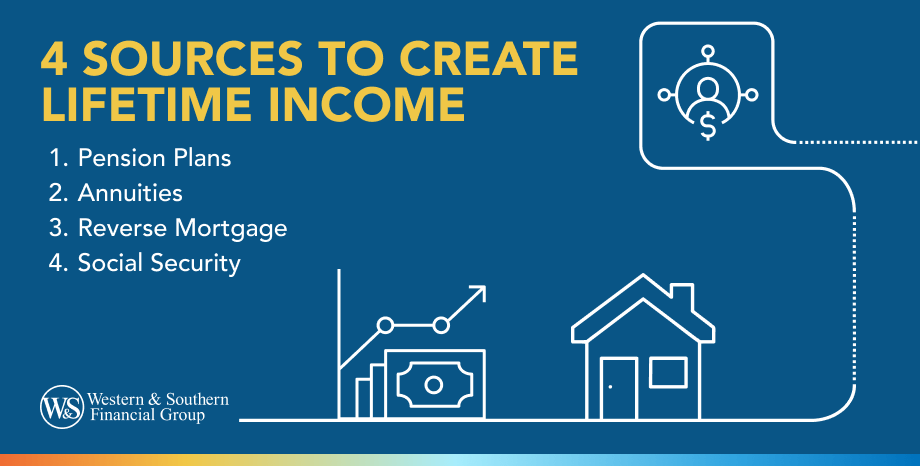
4 Potential Sources of Lifetime Income
An important step in preparing for retirement is estimating how much you need to retire. If your savings may not last as long as expected, or if you are concerned about running out of money, the following options may help.
1. Pension Plans
If you have a pension plan, also known as a defined benefit plan, through your employer, you may receive payments for the rest of your life. These payments are usually based on your salary and how long you worked for the company.
Some pension plans can provide steady monthly income and may continue payments to a spouse if you choose a survivor benefit.
Pension plans are less common today. They are still more likely to be available to government employees, such as firefighters and teachers. Many private-sector workers rely on 401(k) plans and similar accounts instead. Whether you have access to a pension depends on your employer.
2. Annuities
If you do not have a pension, an annuity can offer a similar type of income. Annuities are insurance contracts that can provide income for life.
With an annuity, you can choose to receive payments for your lifetime and, in some cases, for your spouse’s lifetime as well. You typically pay a lump sum to an insurance company. The amount of your payments depends on your age and how much you invest. In general, older individuals receive higher payments.
One concern with annuities is what happens if you pass away early. Payments may stop soon after, which may not meet your goals if you want to leave money to others. Options such as period certain annuities or adding riders may allow payments to continue to beneficiaries, depending on the terms.
To set up an annuity, consider working with a financial professional who can help build an income strategy.
3. Reverse Mortgages
If you have built up equity in your home, a reverse mortgage, also called a home equity conversion mortgage (HECM), can provide additional income or allow for lump sum withdrawals.
Unlike traditional mortgages, reverse mortgages do not require monthly payments. Repayment usually happens after you pass away or when the last borrower leaves the home, often through the sale of the property.
With HECM loans, you are not required to repay more than the value of your home. The lender collects what is available from the sale. If any funds remain after the loan is repaid, they go to you or your beneficiaries.
4. Social Security
Social Security provides lifetime income for most workers. It is backed by the federal government and includes features such as spousal benefits and cost-of-living adjustments.
The amount you receive is based on your earnings history. Higher lifetime earnings generally result in higher benefits.
Social Security can help cover part of your expenses, but it may not be enough on its own. Many people combine it with other income sources or savings withdrawals.
You can choose when to start benefits, usually between ages 62 and 70. Waiting longer can increase your monthly payments. This decision may also affect benefits for a surviving spouse.
If you worked for an employer that did not pay into Social Security, your benefits may be reduced based on other income, such as a pension.
The Bottom Line
Running out of money is a common concern in retirement. Lifetime income sources can help provide ongoing payments for as long as you live. Each option has advantages and trade-offs, and combining several strategies may strengthen your overall approach.
With the right mix of income sources, you can create a plan that supports your lifestyle and helps you manage expenses over time. If you would like guidance, consider speaking with a financial professional who can review your situation and offer recommendations.